

THIBODAUX, La. – Algae and oyster shells are common sights along the bayou, but they aren’t usually considered valuable. A Nicholls Chemistry research team is changing that by testing how these local byproducts can be repurposed into biodiesel.
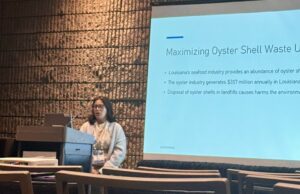 The students aren’t just reading about this in a science book either; they are proving it in the lab and beyond. Nicholls undergraduate Samia Elashry presented the team’s findings at the American Chemical Society Spring 2026 national meeting in Atlanta, Georgia.
The project focuses on a practical problem: while biodiesel is a cleaner alternative to gasoline, it is often too expensive to produce. That is, until the Nicholls team found a way to lower those costs by using what’s available in their own backyard.
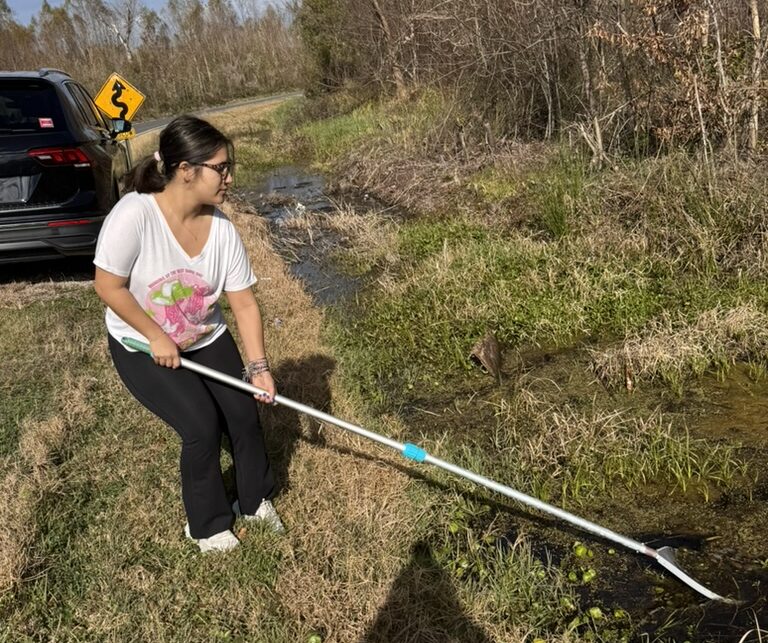
Traditional biodiesel production often uses food crops like soy, which requires vast amounts of land that is not always readily available or conducive to valuable ecosystems. It also relies on expensive chemical catalysts. Nicholls Professor Bello Makama and his students decided to see if they could replace those costly components with local leftovers. Rather than traditional crops, the team collected algae from a nearby ditch and transformed crushed oyster shells into a chemical catalyst.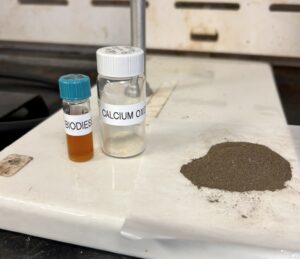
“As a chemist, I sat down and started thinking about projects I could do with my students,” said Professor Makama. “Looking at southern Louisiana, where you have an abundance of algae growing in the ditches and the bayou, we wondered what if we could take something that poses an environmental and logistical issue and add value to it?”
By using the oyster-shell method, the team found they could reduce the cost of the catalyst by 70% to 85%. For Samia, the experience was a lesson in how chemistry can be applied to real-world issues.
“Where we live, we have all these renewable resources that are not being taken advantage of,” says Samia. “Going out into the field, collecting the algae and seeing the algae become biodiesel showed me how we need to work more towards bettering our environment and creating more sustainable resources.”
The team is now focused on making sure their biodiesel is high-quality and energy-efficient. By partnering with a Louisiana-based company, Nicholls students are taking their lab results into the field to test how the fuel performs in different weather and safety conditions.
The goal of the research isn’t just to make fuel in Louisiana, but to show that this “bayou method” can work anywhere. Because algae and shells are found all over the world, other communities could use these same steps to create their own affordable, renewable energy.
“Algae grows in almost every corner of the globe; it has a high lipid content, and it does not compete with arable lands,” Makama said.
At many large universities, complex research can be reserved for graduate students or faculty. At Nicholls, undergraduates like Samia are the ones literally getting their hands dirty and gaining the opportunity to be involved from the field work to the final data analysis.
Nicholls is designed to let students lead the way. The lab isn’t just for those with decades of experience. It’s a place where students can start contributing to real projects before they even graduate. Students don’t have to wait for a career to start asking questions or testing solutions.
To learn more, visit www.nicholls.edu.
FOR IMMEDIATE RELEASE: Tuesday, March 31, 2026
MEDIA CONTACT: Payton Suire
Media Relations & Publications Coordinator,
985.448.4141 or payton.suire@nicholls.edu