
Mass Communication PLANS
DEPARTMENT MENU
Assessment Plan
Data from assessment student-learning objectives has driven curriculum development within the Unit for more than 25 years. The process became formalized in 1999 when the Department adopted its first structured assessment plan. The concepts in William G. Christ’s book on assessment, Assessing Media Education: A Resource Handbook for Educators and Administrators, played a central role in shaping the plan.
The Department of Mass Communication will annually conduct at least one meeting for the purpose of assessment. Assessment of student learning will be a primary focus of this meeting, with particular attention paid to the Accrediting Council on Education in Journalism and Mass Communication’s 10 “Professional Values and Competencies.” Prior to this meeting, faculty will review accumulated data from sources including: Senior Exit Surveys conducted by the University’s Office of Assessment and Institutional Research, Departmental Alumni Surveys, the Pre/Post Test program, the Basic Writing Skills assessment and Internship Reports, among others.
At this meeting, the Department will also conduct its annual review of Senior Essays and Portfolios with participation by faculty and members of area professional media. During the course of the meeting results of the following measures will be examined:
Assessment Measures of Journalistic and Public Relations Skills
(Information Gathering, Writing, Editing, Use of Technology, Principles of Print Design or Broadcast Organization, Analytical Thinking)
Direct
Essay Review; Portfolio Review; ESSAY Results of Questionnaires Completed by Professional Supervisors of Student Internships/Praticums; Basic Writing Skills Assessment
Indirect
Unit Surveys of Alumni, Student and Alumni Data Provided by the University’s Office of Assessment and Institutional Research
Assessment Measures of Student Comprehension of Mass Media Theory and Concepts
(Diversity, Ethics, Mass Media History, Mass Media and Society)
Direct
Pre-/Post-Test; Senior Essay
Indirect
Unit Surveys of Alumni; Student and Alumni Data Provided by the University’s Office of Assessment and Institutional Research
After a review of this data, existing goals will be assessed and future goals will be established.
Departmental Alumni Survey Protocols
Each fall the Department will conduct a survey of graduates one and five years out to gather information on employment and satisfaction with their education.
Results will be compiled in a data-processing program, such as Excel, so that they can be tabulated and archived.
Faculty will evaluate items to insure the continued value to overall departmental assessment and their methodological validity.
Basic Writing Skills Assessment Protocols
The Department will administer the Basic Writing Skills assessment at the sophomore level in MACO 251: News Writing and MACO 252: Reporting, then again in a senior-level course within each concentration (such as MACO 455: Public Affairs Reporting). This 50-item instrument is designed to assess student proficiency in the areas of Associated Press Style, Grammar/Punctuation, Spelling and Word Usage (such as sexist language or redundancy).
Students who do not score at least a 70 percent on this instrument in MACO 251, will be required complete a departmentally created Canvas course in this area while enrolled in MACO 252. Those students who do not score at least 70 percent on the instrument whole enrolled in MACO 252 will not be allowed to progress into higher-level skills courses.
The goal would be to have 80 percent of seniors scoring 80 percent or more; or to see a 75 percent improvement between sophomore and senior scores.
Results will be compiled in a data-processing program, such as Excel, so that they can be tabulated and archived.
Faculty will evaluate items related to measuring ACEJMC values and competencies every five years (next review AY 2026-2027) in order to insure their continued relationship to Council expectations and methodological validity.
Internship/Practicum Reports Protocols
Each semester results from intern supervisor reports will be compiled. The reports will contain items measuring student proficiency in media skills (Analytical Thinking, Editing, Information Gathering, Principles of Print Design or Broadcast Organization, Use of Technology and Writing). They will also include items measuring student professionalism (such as punctuality and dependability).
The goal would be to have 85 percent of students score in the “Highly Agree” or “Agree” range on a five-point scale on all items.
Results will be compiled in a data-processing program, such as Excel, so that they can be tabulated and archived.
Faculty will evaluate items related to measuring ACEJMC values and competencies every five years (next review AY 2026-2027) in order to insure their continued relationship to Council expectations and methodological validity.
Pre-/Post-Test Protocols
The Pre-/Post-Test instrument will be administered each to semester to all MACO 101: Survey of Mass Communication students prior to midterm and to all MACO 490: Digital Media Convergence students following midterm (See attached Pre-Post Instrument). The purpose of this measure is to assess during progress in mastering the 10 “Professional Values and Competencies” expected of graduates from programs accredited by Accrediting Council on Education in Journalism and Mass Communication. Eighty-four items on this instrument are designed to assess student proficiency in these 10 areas. The remaining items are intended to gather information on demographics and media use.
The “Acceptable” score on this instrument will be 70 percent, “Mastery” 85 percent. The goal would be to have 85 percent of seniors score in the “Acceptable” range, or to see a 75 percent improvement between freshmen and senior scores.
Results will be compiled in a data-processing program, such as Excel, so that they can be tabulated and archived.
Faculty will evaluate items related to measuring ACEJMC values and competencies every five years (next review AY 2026-2027) in order to insure their continued relationship to Council expectations and methodological validity.
Senior Essay/Portfolio Review Protocols
Each year, prior to its annual assessment meeting, the Department will conduct a review of essays written by and portfolios prepared by students in the capstone course (MACO 490: Digital Media Convergence). Members of the faculty and area media professionals will conduct this review. Review forms will be completed by each participant prior to the meeting.
Forms for the essay review will reflect measures of student proficiency in the student learning outcomes expected by the Accrediting Council on Education in Journalism and Mass Communication related to mass communication theory – Diversity, Ethics, Mass Media History, Mass Media and Society. Forms for the portfolios review will primarily be directed at assessing student proficiency in ACEJMC’s learning outcomes in the areas of Journalistic and Public Relations Skills – Analytical Thinking, Editing, Information Gathering, Principles of Print Design or Broadcast Organization, Use of Technology and Writing.
The goal would be to have 100% of students score at least a three on a five-points scale, and 60% scoring four or higher.
Once the forms are completed, results will be compiled in a data-processing program, such as Excel, so that it can be tabulated and archived.
Faculty will evaluate items related to measuring ACEJMC values and competencies every five years (next review AY 2026-2027) in order to insure their continued relationship to Council expectations and methodological validity.
Diversity Plan
Nicholls State University’s Mass Communication Department faculty recognizes the value of an education that embraces a wide spectrum of human experience. Such diversity, it is believed, helps develop a broader perspective on issues and facilitates more meaningful social interaction. We strive to create an environment that involves the perspectives of groups that have been historically marginalized based on differences including culture, gender, gender identity, physical differences or race. This includes not only recruiting and retaining a diverse population of faculty, staff and students, but also creating course content and other learning opportunities for addressing media issues relevant to these groups.
Faculty/Staff
The Unit will make a special effort to attract qualified female and minority applicants for open positions, thereby increasing the likelihood that females and minorities will hold representative percentages of positions.
As staff positions are held by civil service employees, the Unit must rely on University recruitment procedures to generate applicant pools. There are University-wide policies designed to ensure adequate numbers of female and minority applicants.
The Unit is largely responsible for soliciting applications for vacant full-time faculty positions. Therefore, the Unit will ensure that whenever it is afforded the opportunity to purchase advertising space for an open faculty position, it will place announcements in the Insight into Diversity online magazine. In addition, special notice will be sent by phone to the state’s historically black universities, including Grambling State University and Southern University. Both universities have mass communication undergraduate programs, and Grambling offers a master’s degree. All notices will include statements urging application by females and minority-group members.
The Department seldom uses adjunct instructors. When it has the opportunity to do so, it will strive to find qualified applicants for the posts through its contacts with area professionals, alumni and colleagues at sister institutions.
As with all junior faculty, the Department will lend whatever assistance it can with scheduling and support services to provide the best possible opportunity for advancement in effort to retain these faculty. It will also promote an atmosphere of inclusion.
The Department will each year host an event designed to foster faculty understanding of diversity issues.
Assessment:
For each open position, the Department will keep a record of the demographic profile of the applicant pool, the demographic profile of those who receive offers and the demographic profile of those who accept positions. In this way, the Unit can evaluate the effectiveness of recruiting efforts. It will keep a record of diversity-training activities.
Students
The Unit will make a special effort to attract and retain qualified female and minority students. In order to attract these students, the Unit will continue to offer scholarships intended for women and minorities. Its digital media sites will continue to serve as platforms for sharing the stories of student success, places where under-represented populations can see the faces of those who look like themselves achieving personal and professional goals. The Department’s website will report enrollment and retention demographics.
In order to retain these students, the faculty will continue efforts to ensure that there are learning opportunities both within and without the curriculum with relevance for all students, including females and members of minority groups.
For more than 25 years, the Department’s minority enrollment (shaped by existing Diversity plans) has exceeded University averages and compared favorably with area demographics. However, the faculty sees opportunity for improvement.
The Department will set one measurable annual goal aimed at increasing recruiting students of Asian descent or who are member of local indigenous nations, toward a goal of doubling the percentage of enrolled students within those groups within five years (Number of students by AY-2026: Asian – Five; Hispanic – 20. Note: As this document is under preparation, the state and nation remain in the grips of the COVID-19 pandemic. Therefore, the Department is setting a conservative goal for the number of new students, as the effects of the pandemic on enrollment overall remain to be seen.)
The overall objective of these efforts will be to maintain a student population within the Department which exceeds University minority representation by at least 10 percent.
Assessment:
Each fall semester the Unit will examine enrollment statistics to determine the demographic profile of its student population.
Curriculum
Curriculum, as used here, is broadly defined to encompass formal course material, as well as extracurricular activities of an educational nature. The Unit will offer classes specifically geared toward addressing diversity issues and will make every effort to include diversity issues in each course where appropriate. The Unit will also strive to ensure representative selection of guest speakers both in and out of class.
Each year the Department will sponsor at least one extra-curricular event, such as special lectures, that addresses diversity issues. This in addition to its existing activities as part of the University’s Black History Month program.
The Department well set a student learning goal of having 90 percent of seniors score at least an 80 percent in the diversity area of the Unit’s Pre-/Post-Test assessment instrument.
Assessment:
Course syllabi will be examined for the inclusion of diversity issues. Each member of the faculty will keep records of guest speakers and special events. At the Unit’s annual assessment meeting each spring, the faculty will examine various records and review syllabi in an effort to evaluate the curriculum’s strength in this area.
5-Year Strategic Plan
The following document outlines the Department’s strategic goals over the next five years. It encompasses specific areas of unit focus addressed in companion plans, including the MACO Assessment Plan, MACO Diversity Plan and MACO Recruitment and Retention Plan. Delineating explicit action items and attendant objectives will serve as the core of each year’s annual planning process. This process centers on an annual assessment meeting at which progress toward the prior year’s objectives are measured and new objectives established. The Department publishes a report on each meeting’s outcome.
FIVE-YEAR GOALS
STUDENT LEARNING OUTCOMES
Goal One: One hundred percent of senior students will meet or exceed departmental benchmarks for assessing student mastery of the 10 “professional values and competencies” expected of majors graduating from programs certified by the Accrediting Council on Education in Journalism and Mass Communications.
Method/Assessment: See MACO Assessment Plan, MACO Annual Plan and MACO Assessment Report(s).
CURRICULUM DEVELOPMENT
Goal One: The Department will establish a certification program in either Sports Journalism or Environmental Communication.
Method/Assessment: See MACO Assessment Plan, MACO Annual Plan and MACO Assessment Report(s).
FACULTY DEVELOPMENT
Goal One: The Department will have five fulltime faculty members in addition to a department head.
Method/Assessment: See MACO Assessment Plan, MACO Annual Plan and MACO Assessment Report(s).
Goal Two: All members of the Department will have earned at least “Distinguished” Student-Advising-and-Mentoring certification.
Method/Assessment: See MACO Annual Plan and MACO Assessment Report(s).
ENROLLMENT
Goal One: The Department will achieve an overall enrollment of 150 students.
Method/Assessment: See Recruitment and Retention Plan
Goal Two: The Department’s enrollment will meet or exceed the demographic profile for diversity representation of the population within the University’s eight-parish service region.
Method/Assessment: See MACO Diversity Plan and Recruitment and Retention Plan
ENDOWMENTS
Goal One: The Department will establish an endowment of at least $250,000 (in addition to those supporting student scholarships) to advance its educational mission.
Method/Assessment: See MACO Annual Plan and MACO Assessment Report(s).
ACCREDITATION
Goal One: The Department win continue to maintain standards expected of ACEJMC certified programs.
Method/Assessment: See MACO Annual Plan and MACO Assessment Report(s)..
THREE-YEAR GOALS
STUDENT LEARNING OUTCOMES
Goal One: Eighty percent of senior students will meet or exceed departmental benchmarks for assessing student mastery of the 10 core values and competencies expected of majors graduating from programs certified by the Accrediting Council on Education in Journalism and Mass Communications.
Method/Assessment: See MACO Annual Plan and MACO Assessment Report(s).
CURRICULUM DEVELOPMENT
Goal One: The Department will establish a certification program in either Sports Journalism or Environmental Communication.
Method/Assessment: See MACO Annual Plan and MACO Assessment Report(s).
FACULTY DEVELOPMENT
Goal One: The Department will return to four fulltime faculty members in addition to a department head.
Method/Assessment: See MACO Annual Plan and MACO Assessment Report(s).
Goal Two: All members of the Department will have earned at least “Certified” Student-Advising-and-Mentoring designation.
Method/Assessment: See MACO Annual Plan and MACO Assessment Report(s).
ENROLLMENT
Goal One: The Department will achieve an overall enrollment of 125 students.
Method: See Recruitment and Retention Plan
Goal Two: The Department’s enrollment will meet or exceed the demographic profile for diversity representation of the population within the University’s eight-parish service region.
Method: See MACO Diversity Plan and Recruitment and Retention Plan
ENDOWMENTS
Goal One: The Department will establish an endowment of at least $125,000 (in addition to those supporting student scholarships) to advance its educational mission.
Method/Assessment: See MACO Annual Plan and MACO Assessment Report(s).
ACCREDITATION
Goal One: The Department will have received renewal of ACEJMC Accreditation.
Method/Assessment: See MACO Annual Plan and MACO Assessment Report(s).
Assessment Plan
(Revised Spring/Summer 2021)
ADD IN ADVISING SURVEY AND SENIOR SURVEY
Data from assessment student-learning objectives has driven curriculum development within
the Unit for more than 25 years. The process became formalized in 1999 when the
Department adopted its first structured assessment plan. The concepts in William G. Christ’s
book on assessment, Assessing Media Education: A Resource Handbook for Educators and
Administrators, played a central role in shaping the plan.
The Department of Mass Communication will annually conduct at least one meeting for the purpose of assessment. Assessment of student learning will be a primary focus of this meeting, with particular attention paid to the Accrediting Council on Education in Journalism and Mass Communication’s 10 “Professional Values and Competencies.” Prior to this meeting, faculty will review accumulated data from sources including: Senior Exit Surveys conducted by the University’s Office of Assessment and Institutional Research, Departmental Alumni Surveys, the Pre/Post Test program, the Basic Writing Skills assessment and Internship Reports, among others.
At this meeting, the Department will also conduct its annual review of Senior Portfolios with participation by faculty and members of area professional media. During the course of the meeting results of the following measures will be examined:
Assessment Measures of Journalistic and Public Relations Skills
(Information Gathering, Writing, Editing, Use of Technology, Principles of Print Design or Broadcast Organization, Analytical Thinking)
Direct
Portfolio Review; Results of Questionnaires Completed by Professional Supervisors of Student Internships/Praticums; Basic Writing Skills Assessment
Indirect
Unit Surveys of Alumni, Student and Alumni Data Provided by the University’s Office of Assessment and Institutional Research
Assessment Measures of Student Comprehension of Mass Media Theory and Concepts
(Diversity, Ethics, Mass Media History, Mass Media and Society)
Direct
Pre-/Post-Test; Senior Essay
Indirect
Unit Surveys of Alumni; Student and Alumni Data Provided by the University’s Office of Assessment and Institutional Research
After a review of this data, existing goals will be assessed and future goals will be established.
Departmental Alumni Survey Protocols
Each fall the Department will conduct a survey of graduates one and five years out to gather information on employment and satisfaction with their education.
Results will be compiled in a data-processing program, such as Excel, so that they can be tabulated and archived.
Faculty will evaluate items to insure the continued value to overall departmental assessment and their methodological validity.
Basic Writing Skills Assessment Protocols
The Department will administer the Basic Writing Skills assessment at the sophomore level in MACO 251: News Writing and MACO 252: Reporting, then again in a senior-level course within each concentration (such as MACO 455: Public Affairs Reporting). This 50-item instrument is (see below) designed to assess student proficiency in the areas of Associated Press Style, Grammar/Punctuation, Spelling and Word Usage (such as sexist language or redundancy).
Students who do not score at least a 70 percent on this instrument in MACO 251, will be required complete a departmentally created Canvas course in this area while enrolled in MACO 252. Those students who do not score at least 70 percent on the instrument whole enrolled in MACO 252 will not be allowed to progress into higher-level skills courses.
The goal would be to have 80 percent of seniors scoring 80 percent or more; or to see a 75 percent improvement between sophomore and senior scores.
Results will be compiled in a data-processing program, such as Excel, so that they can be tabulated and archived.
Faculty will evaluate items related to measuring ACEJMC values and competencies every five years (next review AY 2026-2027) in order to insure their continued relationship to Council expectations and methodological validity.
Internship/Practicum Reports Protocols
Each semester results from intern supervisor reports will be compiled. The reports will contain items measuring student proficiency in media skills (Analytical Thinking, Editing, Information Gathering, Principles of Print Design or Broadcast Organization, Use of Technology and Writing). They will also include items measuring student professionalism (such as punctuality and dependability).
The goal would be to have 85 percent of students score in the “Highly Agree” or “Agree” range on a five-point scale on all items.
Results will be compiled in a data-processing program, such as Excel, so that they can be tabulated and archived.
Faculty will evaluate items related to measuring ACEJMC values and competencies every five years (next review AY 2026-2027) in order to insure their continued relationship to Council expectations and methodological validity.
Pre-/Post-Test Protocols
The Pre-/Post-Test instrument will be administered each to semester to all MACO 101: Survey of Mass Communication students prior to midterm and to all MACO 490: Digital Media Convergence students following midterm (See attached Pre-Post Instrument). The purpose of this measure is to assess during progress in mastering the 10 “Professional Values and Competencies” expected of graduates from programs accredited by Accrediting Council on Education in Journalism and Mass Communication. Eighty-four items on this instrument are designed to assess student proficiency in these 10 areas. The remaining items are intended to gather information on demographics and media use.
The “Acceptable” score on this instrument will be 70 percent, “Mastery” 85 percent. The goal would be to have 85 percent of seniors score in the “Acceptable” range, or to see a 75 percent improvement between freshmen and senior scores.
Results will be compiled in a data-processing program, such as Excel, so that they can be tabulated and archived.
Faculty will evaluate items related to measuring ACEJMC values and competencies every five years (next review AY 2026-2027) in order to insure their continued relationship to Council expectations and methodological validity.
Senior Essay/Portfolio Review Protocols
Each year, prior to its annual assessment meeting, the Department will conduct a review of essays written by and portfolios prepared by students in the capstone course (MACO 490: Digital Media Convergence). Members of the faculty and area media professionals will conduct this review. Review forms (see below) will be completed by each participant prior to the meeting.
Forms for the essay review will reflect measures of student proficiency in the student learning outcomes expected by the Accrediting Council on Education in Journalism and Mass Communication related to mass communication theory – Diversity, Ethics, Mass Media History, Mass Media and Society. Forms for the portfolios review will primarily be directed at assessing student proficiency in ACEJMC’s learning outcomes in the areas of Journalistic and Public Relations Skills – Analytical Thinking, Editing, Information Gathering, Principles of Print Design or Broadcast Organization, Use of Technology and Writing.
The goal would be to have 100% of students score at least a three on a five-points scale, and 60% scoring four or higher.
Once the forms are completed, results will be compiled in a data-processing program, such as Excel, so that it can be tabulated and archived.
Faculty will evaluate items related to measuring ACEJMC values and competencies every five years (next review AY 2026-2027) in order to insure their continued relationship to Council expectations and methodological validity.
MACO ENROLLMENT PLAN
Fall 2021
(Note: This plan reflects a consolidation of exiting recruitment and retention plans.)
Overall enrollment is a function of two functions, recruitment of new students and retention of existing students. The Department has set as a goal an enrollment of 140 students by AY 2025-2026. The purpose of this document is to outline various departmental initiatives directed at either recruitment or retention in pursuit of this goal. At points it may make reference to other existing campaigns.
RECRUITMENT
Goal
The Department’s target is two-percent annual growth in new students.
On-going activities
High School Journalism Workshops: The Department will host annual workshops for area high school students. It will invite participation from Enrollment Services.
High School Visits: Faculty members will conduct five on-site journalism workshops in the University’s service region each year.
Sporting Events: The Department will set up a display at Family Day and host a Homecoming tailgate.
Welcome Back Day: Each year the Department will be a leading participant in Welcome Back Day Activities.
Enrollment Services: At least one faculty member will participate at each Enrollment Services event, Scholars’ Night, Orientation and Colonel Day. All faculty members will be required to attend at least one of these events. It will also send links to the Department’s website and social media platforms to perspective students considering MACO or who are undecided on a major whose names would be provided by Enrollment Services. It will conduct tours of the Department for perspective students arraigned by Enrollment Services.
Undecided Majors: The Department will at least once per year send correspondence to University freshmen who have not decided on a major.
Departmental Tours: Continue to conduct tours of the Department for perspective students arraigned by Department faculty or student organizations.
Transfers: A departmental representative will respond within two work days to any request for a transcript evaluation from the Transfer Student Resource Center (See Report Below under Assessment).
Theater Performance: The present a special, daytime performance of a Nicholls Players production for high school students from the University’s service region each year. It will invite participation from Enrollment Services.
Follow-ups: At each appropriate opportunity, the Department will solicit contact information from prospective students for follow-up communication.
Special Events
The Department will continually seek opportunities for special recruiting activities, and may in its annual plan for a given year outline a particular objective or program.
Messaging
The Department will improve use of its digital-media pages as outlined in the attached 2020 Recruitment plan.
The Department will leverage the newly opened convergence student media space.
The Department will continue to employ High Impact Learning Practices to a significant degree across the Curriculum, and include emphasis on this approach to education in communication with internal and external publics.
It will continue to provide information to the COAL dean and University Relations regarding departmental activities.
Objective(s)
The Department will make contact with at least 70 high school seniors, toward the goal of increasing first-time freshmen enrollment by three percent for fall of AY 2022-2023.
Assessment
The Department will compile an Annual Recruitment Report (Below). This report will include the number of contacts with prospective students and any follow-actions.
At its annual assessment meeting the faculty will review data on enrollment provided by the Office of Institutional Assessment.
Annual Recruitment Contact Report
|
Event |
Number of Students |
Student Names |
Contact Information |
Follow-up |
Prospective-Student Contact Information
_______(EVENT)_______
|
Student Names |
Contact Information |
Follow-up (Method/Date) |
Transfer Student Report
|
Student |
Concentration |
Date Received |
Date of Response |
RETENTION
Goal
The most recent cohort (F2014) had a six-year graduation rate in the Department of 16.7 percent and 50 percent overall at the University (this last figure exceeds the University average). At the end of four years, the retention rate within the program was 20 percent and 53.3 percent at the University overall.
The Department’s targets will be to increase the six-year graduation rate and four-year retention rate for the Fall 2021 Cohort within the Unit by 20 percent across all demographic groups.
On-going activities
Student Media: The Department will continue supervision of the following student media operations – KNSU-FM radio Station, KNSU-TV, The Nicholls Worth online and three magazines (Chezy Nous, Garde Voir Ci and The Nicholls Worth).
Student Organizations: The Department will continue to sponsor the following student honor or professional organizations – Kappa Tau Alpha, Radio Television Digital News Association, Society for Professional Journalists and Public Relations Student Society of America.
Internship Opportunities: The Department will continue to expand internship opportunities, include making publicity related to them more efficient.
High Impact Learning Practices: The Department utilizes HIPs extensively. Of the Unit’s 32 courses, 84.4 percent employ at least one HIP (The remaining five classes are production courses). Almost 69 percent of the classes utilize more than one (2.16 on average), and more than 15 percent use as many as four. The Department will continue this focus.
Diversity: As stated in its Diversity Plan, Department faculty recognizes the value of an education that embraces a wide spectrum of human experience. This includes fostering a classroom environment that includes the perspectives of groups that have been historically marginalized based on culture, gender, gender identity or race and creating course content and other learning opportunities for addressing media issues relevant to these marginalized groups.
Sporting Events: The Department will host a tailgate party at Homecoming each year.
Special Events: The Department may plan in a given year an event or events designed to promote a feeling of belonging among students, such as apparel merchandise sales.
Transition Plan: The Department will continue to work with representatives from Academic Advising to make transition to departmental advising as efficient as possible. This include faculty receiving specialized training on AA processes and interacting with UNIV 101 courses.
Advising: The Department will continue efforts to provide effective advising, and will each year hold an orientation program for majors.
Remediation: The Department will maintain a Moodle-based course on Basic Writing Skills to assist students develop the skills needed to achieve the required scores on that assessment instrument.
Messaging
Course syllabi will include those HIPs utilized therein.
Course syllabi will highlight those activities that address matters related to diversity.
The Department will
Objective(s)
The Department will make contact with at least 70 high school seniors, toward the goal of increasing first-time freshmen enrollment by three percent for fall of AY 2022-2023.
Assessment
The Department will every two years (next AY 2022-2023) review syllabi with regards to inclusion of HIPs and Diversity issues.
The Department will each year compile a report on activities directed at retention that will be reviewed at the annual assessment meeting.
The Department will review retention data provided by the Office of Institutional Assessment.
Each year the Department will review data on student satisfaction with departmental advising provided by the Office of Institutional Assessment.
High Impact Table (Partial)
Department of Mass Communication
Diversity Plan
(Created 2004, Amended 2017, Amended 2021)
Nicholls State University’s Mass Communication Department faculty recognizes the value of an education that embraces a wide spectrum of human experience. Such diversity, it is believed, helps develop a broader perspective on issues and facilitates more meaningful social interaction. We strive to create an environment that involves the perspectives of groups that have been historically marginalized based on differences including culture, gender, gender identity, physical differences or race. This includes not only recruiting and retaining a diverse population of faculty, staff and students, but also creating course content and other learning opportunities for addressing media issues relevant to these groups.
Faculty/Staff
The Unit will make a special effort to attract qualified female and minority applicants for open positions, thereby increasing the likelihood that females and minorities will hold representative percentages of positions.
As staff positions are held by civil service employees, the Unit must rely on University recruitment procedures to generate applicant pools. There are University-wide policies designed to ensure adequate numbers of female and minority applicants.
The Unit is largely responsible for soliciting applications for vacant full-time faculty positions. Therefore, the Unit will ensure that whenever it is afforded the opportunity to purchase advertising space for an open faculty position, it will place announcements in the Insight into Diversity online magazine. In addition, special notice will be sent by phone to the state’s historically black universities, including Grambling State University and Southern University. Both universities have mass communication undergraduate programs, and Grambling offers a master’s degree. All notices will include statements urging application by females and minority-group members.
The Department seldom uses adjunct instructors. When it has the opportunity to do so, it will strive to find qualified applicants for the posts through its contacts with area professionals, alumni and colleagues at sister institutions.
As with all junior faculty, the Department will lend whatever assistance it can with scheduling and support services to provide the best possible opportunity for advancement in effort to retain these faculty. It will also promote an atmosphere of inclusion.
The Department will each year host an event designed to foster faculty understanding of diversity issues.
Assessment:
For each open position, the Department will keep a record of the demographic profile of the applicant pool, the demographic profile of those who receive offers and the demographic profile of those who accept positions. In this way, the Unit can evaluate the effectiveness of recruiting efforts. It will keep a record of diversity-training activities.
Students
The Unit will make a special effort to attract and retain qualified female and minority students. In order to attract these students, the Unit will continue to offer scholarships intended for women and minorities. Its digital media sites will continue to serve as platforms for sharing the stories of student success, places where under-represented populations can see the faces of those who look like themselves achieving personal and professional goals. The Department’s website will report enrollment and retention demographics.
In order to retain these students, the faculty will continue efforts to ensure that there are learning opportunities both with and without the curriculum with relevance for all students, including females and members of minority groups.
For more than 25 years, the Department’s minority enrollment (shaped by existing Diversity plans) has exceeded University averages and compared favorably with area demographics. However, the faculty sees opportunity for improvement.
The Department will set one measurable annual goal aimed at increasing recruiting students of Asian descent or who are member of local indigenous nations, toward a goal of doubling the percentage of enrolled students within those groups within five years (Number of students by AY-2026: Asian – Five; Hispanic – 20. Note: As this document is under preparation, the state and nation remain in the grips of the COVID-19 pandemic. Therefore, the Department is setting a conservative goal for the number of new students, as the effects of the pandemic on enrollment overall remain to be seen.)
The overall objective of these efforts will be to maintain a student population within the Department which exceeds University minority representation by at least 10 percent.
Assessment:
Each fall semester the Unit will examine enrollment statistics to determine the demographic profile of its student population.
Curriculum
Curriculum, as used here, is broadly defined to encompass formal course material, as well as extracurricular activities of an educational nature. The Unit will offer classes specifically geared toward addressing diversity issues and will make every effort to include diversity issues in each course where appropriate. The Unit will also strive to ensure representative selection of guest speakers both in and out of class.
Each year the Department will sponsor at least one extra-curricular event, such as special lectures, that addresses diversity issues. This in addition to its existing activities as part of the University’s Black History Month program.
The Department well set a student learning goal of having 90 percent of seniors score at least an 80 percent in the diversity area of the Unit’s Pre-/Post-Test assessment instrument.
Assessment:
Course syllabi will be examined for the inclusion of diversity issues. Each member of the faculty will keep records of guest speakers and special events. At the Unit’s annual assessment meeting each spring, the faculty will examine various records and review syllabi in an effort to evaluate the curriculum’s strength in this area.
Enrollment Plan
Fall 2021
(Note: This plan reflects a consolidation of exiting recruitment and retention plans.)
Overall enrollment is a function of two functions, recruitment of new students and retention of existing students. The Department has set as a goal an enrollment of 140 students by AY 2025-2026. The purpose of this document is to outline various departmental initiatives directed at either recruitment or retention in pursuit of this goal. At points it may make reference to other existing campaigns.
RECRUITMENT
Goal
The Department’s target is two-percent annual growth in new students.
On-going activities
High School Journalism Workshops: The Department will host annual workshops for area high school students. It will invite participation from Enrollment Services.
High School Visits: Faculty members will conduct five on-site journalism workshops in the University’s service region each year.
Sporting Events: The Department will set up a display at Family Day and host a Homecoming tailgate.
Welcome Back Day: Each year the Department will be a leading participant in Welcome Back Day Activities.
Enrollment Services: At least one faculty member will participate at each Enrollment Services event, Scholars’ Night, Orientation and Colonel Day. All faculty members will be required to attend at least one of these events. It will also send links to the Department’s website and social media platforms to perspective students considering MACO or who are undecided on a major whose names would be provided by Enrollment Services. It will conduct tours of the Department for perspective students arraigned by Enrollment Services.
Undecided Majors: The Department will at least once per year send correspondence to University freshmen who have not decided on a major.
Departmental Tours: Continue to conduct tours of the Department for prospective students arraigned by Department faculty or student organizations.
Transfers: A departmental representative will respond within two work days to any request for a transcript evaluation from the Transfer Student Resource Center (See Report Below under Assessment).
Theater Performance: The present a special, daytime performance of a Nicholls Players production for high school students from the University’s service region each year. It will invite participation from Enrollment Services.
Follow-ups: At each appropriate opportunity, the Department will solicit contact information from prospective students for follow-up communication.
Special Events
The Department will continually seek opportunities for special recruiting activities, and may in its annual plan for a given year outline a particular objective or program.
Messaging
The Department will improve use of its digital-media pages as outlined in the attached 2020 Recruitment plan.
The Department will leverage the newly opened convergence student media space.
The Department will continue to employ High Impact Learning Practices to a significant degree across the Curriculum, and include emphasis on this approach to education in communication with internal and external publics.
It will continue to provide information to the COAL dean and University Relations regarding departmental activities.
Objective(s)
The Department will make contact with at least 70 high school seniors, toward the goal of increasing first-time freshmen enrollment by three percent for fall of AY 2022-2023.
Assessment
The Department will compile an Annual Recruitment Report (Below). This report will include the number of contacts with prospective students and any follow-actions.
At its annual assessment meeting the faculty will review data on enrollment provided by the Office of Institutional Assessment.
Annual Recruitment Contact Report
Event | Number of Students | Student Names | Contact Information | Follow-up |
|
|
|
|
|
|
|
|
|
|
Prospective-Student Contact Information
_______(EVENT)_______
Student Names | Contact Information | Follow-up (Method/Date) |
|
|
|
Transfer Student Report
Student | Concentration | Date Received | Date of Response |
|
|
|
|
|
|
|
|
RETENTION
Goal
The most recent cohort (F2014) had a six-year graduation rate in the Department of 16.7 percent and 50 percent overall at the University (this last figure exceeds the University average). At the end of four years, the retention rate within the program was 20 percent and 53.3 percent at the University overall.
The Department’s targets will be to increase the six-year graduation rate and four-year retention rate for the Fall 2021 Cohort within the Unit by 20 percent across all demographic groups.
On-going activities
Student Media: The Department will continue supervision of the following student media operations – KNSU-FM radio Station, KNSU-TV, The Nicholls Worth online and three magazines (Chezy Nous, Garde Voir Ci and The Nicholls Worth).
Student Organizations: The Department will continue to sponsor the following student honor or professional organizations – Kappa Tau Alpha, Radio Television Digital News Association, Society for Professional Journalists and Public Relations Student Society of America.
Internship Opportunities: The Department will continue to expand internship opportunities, include making publicity related to them more efficient.
High Impact Learning Practices: The Department utilizes HIPs extensively. Of the Unit’s 32 courses, 84.4 percent employ at least one HIP (The remaining five classes are production courses). Almost 69 percent of the classes utilize more than one (2.16 on average), and more than 15 percent use as many as four. The Department will continue this focus.
Diversity: As stated in its Diversity Plan, Department faculty recognizes the value of an education that embraces a wide spectrum of human experience. This includes fostering a classroom environment that includes the perspectives of groups that have been historically marginalized based on culture, gender, gender identity or race and creating course content and other learning opportunities for addressing media issues relevant to these marginalized groups.
Sporting Events: The Department will host a tailgate party at Homecoming each year.
Special Events: The Department may plan in a given year an event or events designed to promote a feeling of belonging among students, such as apparel merchandise sales.
Transition Plan: The Department will continue to work with representatives from Academic Advising to make transition to departmental advising as efficient as possible. This include faculty receiving specialized training on AA processes and interacting with UNIV 101 courses.
Advising: The Department will continue efforts to provide effective advising, and will each year hold an orientation program for majors.
Remediation: The Department will maintain a Moodle-based course on Basic Writing Skills to assist students develop the skills needed to achieve the required scores on that assessment instrument.
Messaging
Course syllabi will include those HIPs utilized therein.
Course syllabi will highlight those activities that address matters related to diversity.
The Department will
Objective(s)
The Department will make contact with at least 70 high school seniors, toward the goal of increasing first-time freshmen enrollment by three percent for fall of AY 2022-2023.
Assessment
The Department will every two years (next AY 2022-2023) review syllabi with regards to inclusion of HIPs and Diversity issues.
The Department will each year compile a report on activities directed at retention that will be reviewed at the annual assessment meeting.
The Department will review retention data provided by the Office of Institutional Assessment.
Each year the Department will review data on student satisfaction with departmental advising provided by the Office of Institutional Assessment.
High Impact Table (Partial)
CONTACT INFORMATION
Department of Mass Communication (MACO)
Office Location
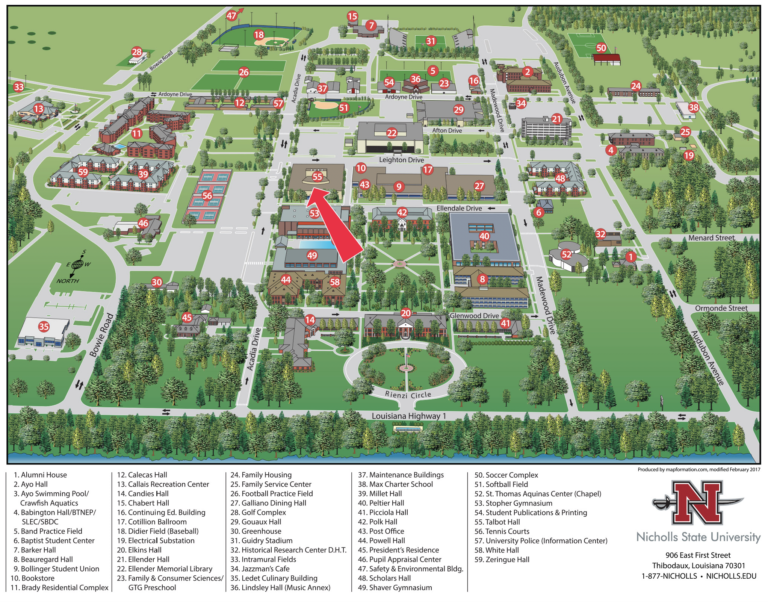
102 Talbot Hall
Mailing Address
PO Box 2031, Thibodaux, LA 70310
Phone
985.448.4586
fax: 985.448.4577
Dr. James Stewart, Head
CAMPUS LOCATION